Tiger butterfly Frederic C Moore


Product images of Tiger butterfly




Sizing information
| Overall size (inc frame) | x cm ( x in) |
| Depth | cm (in) |
| Artwork | x cm ( x in) |
| Border (mount) |
cm
top/bottom
(in)
cm left/right (in) |
| The paper size of our wall art shipped from the US is sized to the nearest inch. | |
 zoom
zoom
Tiger butterfly
Entomological studies of butterflies.
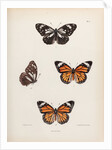
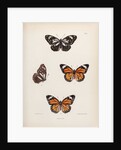
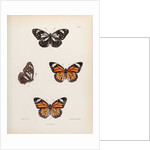
Figures 1 and 1a are male and female Parantica taprobana, or Ceylon tiger butterflies, referred to here as Chittira fumata. Their uppersides are rich brown, as are their forewings, deeper in the male than in the female. Both forewings are spotted with greenish-white.
Figures 2 and 2a are male and female Danaus genutia, or common tiger butterflies, referred to here as Salatura genutia. Also known as the striped tiger to differentiate it from the plain tiger butterfly. Their uppersides are orange, and their forewings are brownish-orange, with a black marginal band covered in white spots.
Plate 4 from The Lepidoptera of Ceylon, by Frederic Moore, vol. 1 (1880-1881). Frederic Moore (1830-1907) British entomologist was not a Fellow of the Royal Society. Moore's son, Frederic C Moore, illustrated this volume.
Entomological studies of butterflies.
Figures 1 and 1a are male and female Parantica taprobana, or Ceylon tiger butterflies, referred to here as Chittira fumata. Their uppersides are rich brown, as are their forewings, deeper in the male than in the female. Both forewings are spotted with greenish-white.
Figures 2 and 2a are male and female Danaus genutia, or common tiger butterflies, referred to here as Salatura genutia. Also known as the striped tiger to differentiate it from the plain tiger butterfly. Their uppersides are orange, and their forewings are brownish-orange, with a black marginal band covered in white spots.
Plate 4 from The Lepidoptera of Ceylon, by Frederic Moore, vol. 1 (1880-1881). Frederic Moore (1830-1907) British entomologist was not a Fellow of the Royal Society. Moore's son, Frederic C Moore, illustrated this volume.
Entomological studies of butterflies.
Figures 1 and 1a are male and female Parantica taprobana, or Ceylon tiger butterflies, referred to here as Chittira fumata. Their uppersides are rich brown, as are their forewings, deeper in the male than in the female. Both forewings are spotted with greenish-white.
Figures 2 and 2a are male and female Danaus genutia, or common tiger butterflies, referred to here as Salatura genutia. Also known as the striped tiger to differentiate it from the plain tiger butterfly. Their uppersides are orange, and their forewings are brownish-orange, with a black marginal band covered in white spots.
Plate 4 from The Lepidoptera of Ceylon, by Frederic Moore, vol. 1 (1880-1881). Frederic Moore (1830-1907) British entomologist was not a Fellow of the Royal Society. Moore's son, Frederic C Moore, illustrated this volume.
Entomological studies of butterflies.
Figures 1 and 1a are male and female Parantica taprobana, or Ceylon tiger butterflies, referred to here as Chittira fumata. Their uppersides are rich brown, as are their forewings, deeper in the male than in the female. Both forewings are spotted with greenish-white.
Figures 2 and 2a are male and female Danaus genutia, or common tiger butterflies, referred to here as Salatura genutia. Also known as the striped tiger to differentiate it from the plain tiger butterfly. Their uppersides are orange, and their forewings are brownish-orange, with a black marginal band covered in white spots.
Plate 4 from The Lepidoptera of Ceylon, by Frederic Moore, vol. 1 (1880-1881). Frederic Moore (1830-1907) British entomologist was not a Fellow of the Royal Society. Moore's son, Frederic C Moore, illustrated this volume.
Entomological studies of butterflies.
Figures 1 and 1a are male and female Parantica taprobana, or Ceylon tiger butterflies, referred to here as Chittira fumata. Their uppersides are rich brown, as are their forewings, deeper in the male than in the female. Both forewings are spotted with greenish-white.
Figures 2 and 2a are male and female Danaus genutia, or common tiger butterflies, referred to here as Salatura genutia. Also known as the striped tiger to differentiate it from the plain tiger butterfly. Their uppersides are orange, and their forewings are brownish-orange, with a black marginal band covered in white spots.
Plate 4 from The Lepidoptera of Ceylon, by Frederic Moore, vol. 1 (1880-1881). Frederic Moore (1830-1907) British entomologist was not a Fellow of the Royal Society. Moore's son, Frederic C Moore, illustrated this volume.
- Image reference: RS-14182
- ©The Royal Society
Discover more
More by the artist Frederic C Moore.
Explore the collection Animals and nature prints and drawings.
Our framed prints
Every framed picture is created by hand in our workshop by specialist framers.
Black, white, brown, silver, gold or natural frames available, supplied ready to hang.
All our frames have a smooth satin finish, and measure 20mm (front face) by 23mm (depth from wall).
Read more about our framed art prints.
Manufactured in the UK
All products are printed in the UK, using the latest digital presses and a giclée printmaking process.
We only use premium branded inks, and colours are independently verified to last between 100 and 200 years.
Delivery and returns
We print everything to order so delivery times may vary but all framed pictures are despatched within 5-7 days via courier or recorded mail.
Delivery to the UK is £10 for a single framed print.
We will happily replace your order if everything isn’t 100% perfect.